Book Categories:
Guides
Which Deity Is Calling Me? Signs, a 7-Card Deity Tarot Spread and a Deity Table

Share:

Book Categories:


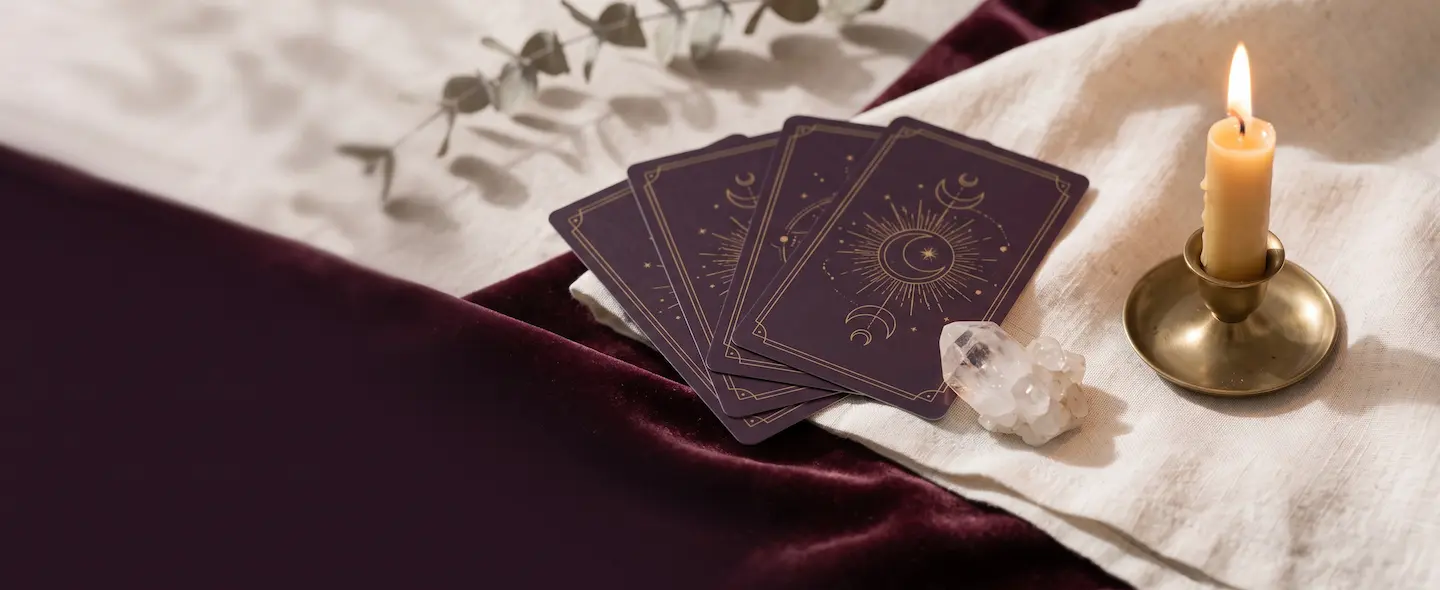
“Which deity is calling me?” is one of the questions I am asked most often, and it usually arrives with a story: a name that keeps appearing, an animal that will not leave you alone, a dream, a sudden pull toward a goddess you knew nothing about last month. A deity tarot reading is a structured way to take that pull seriously without either dismissing it or handing your judgment over to it. This guide explains what deity work is and what it is not, the most common signs people report, a seven-card deity tarot spread you can lay yourself, a table of deities and the tarot cards and signs traditionally linked with them, how to respond respectfully once you have an answer, and the mistakes I see most.
I’m Meriem. The Deity Tarot Reading is among the most reviewed readings at PuraTarot, and the requests come from every background: practicing pagans, curious agnostics, Catholics who keep dreaming about a woman in blue. Here is how I approach it.
People experience the sacred through figures: gods, goddesses, saints, ancestors, archetypes. Whether you understand a deity as a literal being, a face of the divine, or a pattern in the psyche (the Jungian view), the experience of being “called” is the same from the inside: something keeps knocking. A deity tarot reading does not prove who is knocking. It does what tarot does best: it lays the symbols out so you can see the shape of the pattern, and it gives you language for what you are already sensing.
Three honest limits. A reading cannot confirm a deity’s existence or intentions. It cannot replace the traditions and communities that have kept a deity’s practice alive; if a figure from a living tradition is calling you, learn from that tradition. And it should never be used to justify something harmful “because the goddess told me to.” If a reading ever seems to say that, the reading is wrong.
A single sign is a coincidence. Three kinds of signs over a few weeks are a pattern. Keep a list; the reading is far more useful when you bring one.
Pull this after at least a week of noting signs. Shuffle while asking, silently, “Who is reaching toward me, and why now?” Lay the cards in two rows: three on top, four below.
Then match cards 2 and 3 against the table below. Do not force a name; if nothing fits cleanly, the call may be to a tradition or an archetype rather than a single figure, and that is a valid answer.
Traditions differ, and this table is a starting map, not a rulebook. Where a deity belongs to a living, closed or initiatory tradition, treat the entry as an invitation to learn from that tradition rather than to adopt the deity on your own.
| Deity | Domain | Tarot cards often linked | Signs people report |
|---|---|---|---|
| Aphrodite / Venus | Love, beauty, desire | The Empress, The Lovers, Two of Cups | Roses, doves, seashells, sudden interest in self-adornment, the number 6 |
| Hecate | Crossroads, magic, thresholds | The High Priestess, The Moon, The Hermit | Keys, dogs, crossroads, torches, being awake at 3 a.m., the number 3 |
| Persephone | Descent, return, seasons | Death, Judgement, Six of Swords | Pomegranates, spring flowers, grief that turns into growth |
| Athena | Wisdom, strategy, craft | Queen of Swords, Justice, The Magician | Owls, olive branches, a pull toward study and clear decisions |
| Artemis / Diana | Wildness, independence, protection | The Moon, Queen of Wands, Nine of Pentacles | Deer, bows, the moon, a need for solitude and boundaries |
| Freya | Love, war, seidr, gold | The Empress, The Chariot, Queen of Wands | Cats, falcons, amber, boars, a mix of tenderness and ferocity |
| Brigid | Hearth, healing, poetry, forge | Temperance, The Star, Ace of Wands | Flames, wells, swans, a pull toward making and mending |
| The Morrígan | Sovereignty, battle, prophecy | The Tower, Death, Queen of Swords | Crows and ravens in numbers, a call to reclaim power after being diminished |
| Hermes / Mercury | Messages, travel, trickery, thresholds | The Magician, The Fool, Eight of Wands | Coins found on the ground, sudden travel, synchronicities in messages |
| Isis / Aset | Magic, motherhood, restoration | The High Priestess, The Empress, The Star | Wings, the throne, a pull to gather what was scattered |
| Lilith | Autonomy, refusal, the night | The Devil (reclaimed), The Moon, Queen of Swords | Owls, screech-owls, night visitors, anger at being made small |
| Kali | Time, destruction of illusion, fierce love | The Tower, Death, Strength | Sudden endings that turn out to be rescues; a pull toward living Hindu practice, which should be learned from that tradition |
If you have a list of signs and no name yet, that is exactly the reading I write most. Put your signs, dreams and dates in the box on the product page for the Deity Tarot Reading, and I will lay the seven cards, name the figure the symbols point toward, and write what they may be asking, as a PDF with a photo of your spread. $14.99, in your inbox within the hour on Same Hour.
Keep a list of repeated signs for a week or more (animals, symbols, names, dreams, numbers), then pull a deity tarot spread that asks about domain, character, timing and what is being asked. Match the domain and character cards against a deity table, and confirm through learning the myths rather than through a single card.
Most people describe a mix of familiarity and being slightly out of their depth: a symbol keeps appearing, a fascination arrives from nowhere, dreams carry a presence, and the timing lines up with a threshold in their life. It rarely feels like a voice; it feels like a pattern.
Tarot can show the domain, character and timing of a call and point toward the figures whose symbols match. It cannot prove a patron relationship; that comes from practice and time.
Then the spread usually shows an inner need, an ancestor, or your own higher self asking for attention, which is just as valid and often more useful. Not being called is not a failure.
Working respectfully with a deity should make you steadier, not more frightened. The danger comes from using “the deity said so” to override your own judgment, or from taking figures from closed traditions without learning from them.
If you would rather have me lay the spread and write it up, these are the options. Each arrives as a PDF with a photo of your cards. You write your details in the box on the product page, choose Same Hour or Same Day, and that is all; if you cancel before I begin, you are refunded in full.
Browse all readings in Spiritual Guidance, or read how ordering works.
Your personal reading
Send me your question and the details that matter. I read your energy first and the cards second, then write your reading as a long, personal letter and deliver it to your inbox as a beautifully designed PDF, Same Hour or Same Day.
From $13.99 · Delivered by email, 24/7 · Private and written just for you